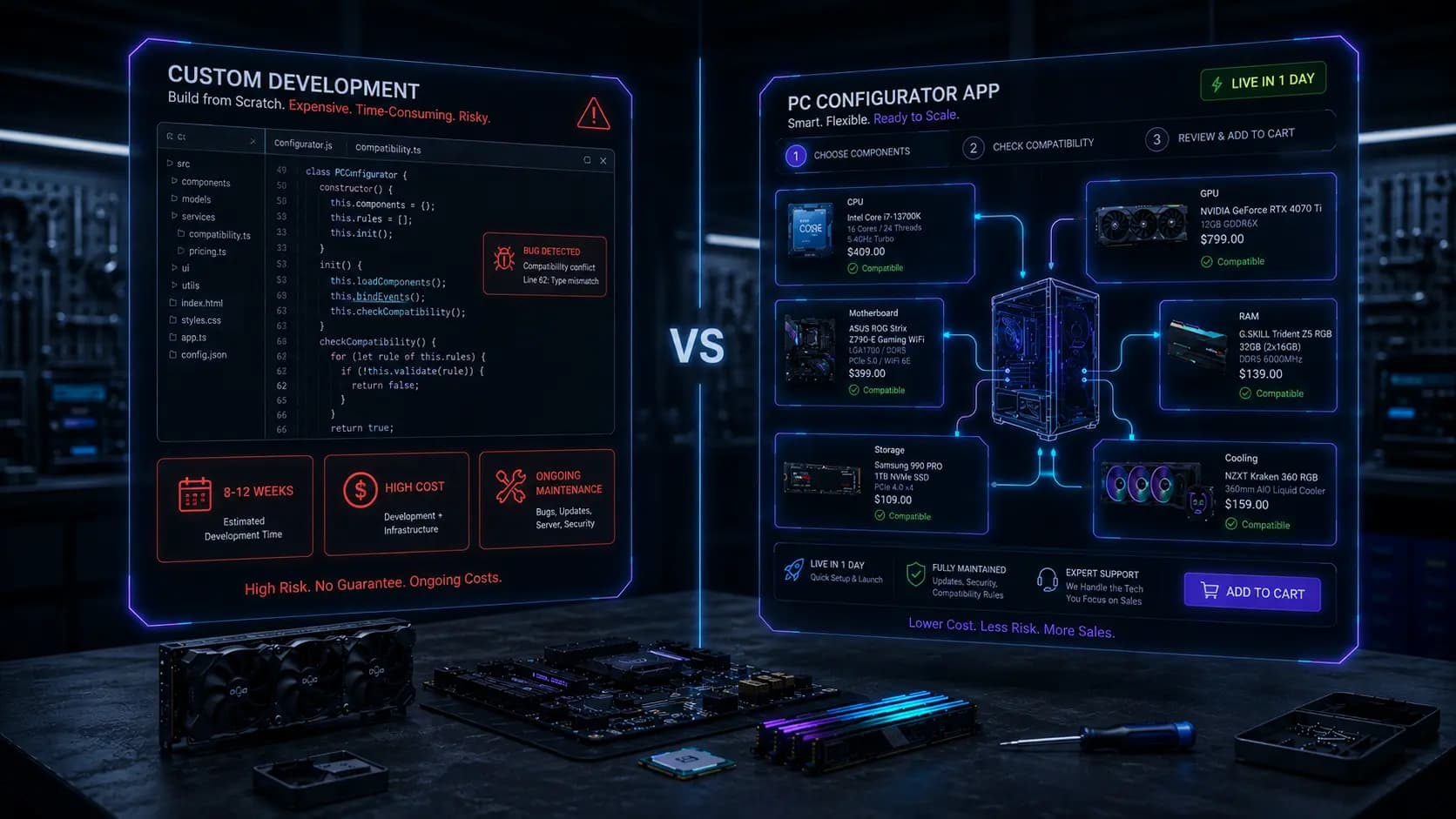
Build vs. Buy: The Real Question Behind a PC Configurator
Quick Summary: Custom-building a PC configurator gives you full control over logic and design, but the true cost isn't the initial build — it's the ongoing maintenance of compatibility rules, cart integration, and admin tooling as your catalog and Shopify's platform both keep changing. For the vast majority of Shopify PC stores, a dedicated configurator app reaches revenue faster and stays cheaper over a 2-3 year horizon. Custom development still makes sense for a smaller set of stores with genuinely unusual business logic or an in-house engineering team that will maintain it indefinitely.
Every Shopify merchant selling PC parts or custom builds eventually asks the same question: should we hire developers to build our own configurator, or install an app that already does this? The honest answer depends less on budget and more on what happens after launch, because a PC configurator is not a one-time build — it's a system that needs to keep working as your catalog, Shopify's APIs, and customer expectations all shift.
This guide breaks down what custom development actually involves, what it costs beyond the initial invoice, and the specific situations where building your own still makes sense.
What Does Custom Development Actually Give You?
The appeal of custom development is real. When you build your own configurator, you control every detail — the exact selection flow, the precise compatibility logic for your specific product mix, and integration points with any internal systems you already run (ERP, custom pricing engines, B2B quoting tools).
If your business has genuinely unusual requirements — for example, a build process that isn't really "PC parts" at all but a hybrid of hardware and bespoke services, or compatibility rules that don't map to standard socket/chipset/wattage logic — custom development lets you encode that exactly, without working around an app's assumptions.
Full Control Over Logic and UX
A custom build means no compromises on how selection steps are ordered, how pricing displays update, or how edge cases in your catalog are handled. You're not filing feature requests and waiting for a roadmap; you decide what the tool does.
Deep Integration With Existing Systems
If you already run custom internal tools for inventory, quoting, or fulfillment, a bespoke configurator can be built to talk directly to those systems instead of working through an app's data model.
What Does Custom Development Actually Cost?
This is where most build-vs-buy decisions go wrong — not because the initial build estimate is dishonest, but because it only covers phase one.
The Initial Build
A working PC configurator needs, at minimum: a step-based selection UI, a compatibility rules engine (socket matching, wattage totals, form-factor checks, memory type validation), Shopify cart and checkout integration, an admin interface for merchants to manage products and rules, and inventory/price sync logic that keeps the configurator accurate as the Shopify catalog changes. Each of these is its own scoped project, not a checkbox — the rules engine alone is often underestimated, since "just check if parts are compatible" quickly turns into dozens of interacting conditions once a catalog grows past a handful of SKUs per category.
The Ongoing Maintenance Bill
This is the part that rarely makes it into the initial pitch:
- Shopify API changes. Shopify's Admin API, checkout extensibility, and theme architecture evolve on their own schedule. A custom integration needs someone watching for deprecations and updating code accordingly — indefinitely.
- Compatibility rule upkeep. Every time you add a new CPU generation, GPU line, or connector standard, someone has to update the rules engine. This is a recurring engineering task, not a one-time setup, for as long as you sell PC parts.
- Admin tooling debt. The internal dashboard that lets non-technical staff manage products and rules needs its own maintenance, bug fixes, and usability improvements as your team's workflow changes.
- Bus factor risk. If the developer or agency that built your configurator moves on, you inherit an undocumented, bespoke system that the next hire has to learn from scratch.
Opportunity Cost
A custom build realistically takes weeks to a few months before it's production-ready, depending on scope and how experienced the team is with Shopify's app and theme architecture. Every week before launch is a week without a configurator converting browsers into bigger baskets. For a seasonal business (back-to-school builds, holiday gaming PCs), a missed launch window can matter more than the development cost itself.
ApproachUpfront Cost / TimeOngoing Maintenance BurdenTime to LaunchWho It Fits
Custom DevelopmentHigh — weeks to months of developer timeContinuous — API changes, rule updates, admin tooling, bug fixesSlow — full build before you can testStores with unique logic or an in-house dev team committed long-term
Dedicated Configurator AppLow — install and configureLow — vendor maintains the compatibility engine and Shopify integrationFast — typically live within a dayMost Shopify PC parts and custom-build stores
Generic Product-Option AppLow — install and configureLow, but options are shallowFast, but limited to single-product optionsStores with simple option needs, not real cross-product compatibility
When a Dedicated App Is the Better Call
For most Shopify merchants selling PC parts or custom builds, a dedicated configurator app is the more rational choice, for a simple reason: the compatibility engine, cart integration, and admin tooling are the vendor's core product, maintained continuously as part of their business — not a side project your team has to keep funding.
This matters most for stores that don't have a dedicated in-house engineering team, since the ongoing maintenance cost of a custom build falls entirely on whoever is available at the time, which is rarely a sustainable position for a growing retail business. An app also typically reaches live traffic in a day rather than weeks, which matters directly for revenue timing.
When Custom Development Still Makes Sense
Custom development isn't the wrong answer for every store. It's the right call when:
- Your compatibility logic genuinely doesn't fit standard PC component relationships (for example, a hybrid hardware-plus-service configurator unrelated to socket/wattage rules).
- You already have an in-house engineering team that will own and maintain the system indefinitely as a core part of the business, not a project handed off after launch.
- Your scale or workflow requirements go meaningfully beyond what a general-purpose configurator app is built to support, and you've confirmed this by actually evaluating apps first rather than assuming it.
If none of these apply, the maintenance burden of custom development usually outweighs the control it provides.
Frequently Asked Questions
Is a custom-built PC configurator always more expensive than an app?
Not always at the initial build stage, but over a 2-3 year horizon the ongoing maintenance of compatibility rules, Shopify API changes, and admin tooling usually makes custom development the more expensive path for typical PC parts stores.
Can I start with an app and move to custom development later?
Yes. Many stores start with a dedicated app to validate demand and get compatibility logic right, then consider custom development later only if they hit a genuine limitation — which is a much lower-risk sequence than building custom first.
What's the biggest hidden cost of custom development?
Ongoing maintenance — specifically keeping the compatibility rules engine current as new components launch, and keeping the Shopify integration working as Shopify's APIs change. This cost never stops as long as you're selling PC parts.
Does a dedicated app limit how much I can customize the buying experience?
A good dedicated configurator app still allows theme-level customization — colors, layouts, step names, and embedding — without requiring you to build or maintain the underlying compatibility and checkout logic yourself.
How do I evaluate whether my business needs custom development?
List the specific things a general-purpose configurator app can't do for your catalog, then confirm those gaps actually exist by testing an app first. Most stores find that a dedicated app covers their real requirements, and the perceived need for custom development doesn't hold up once they've actually tried one.