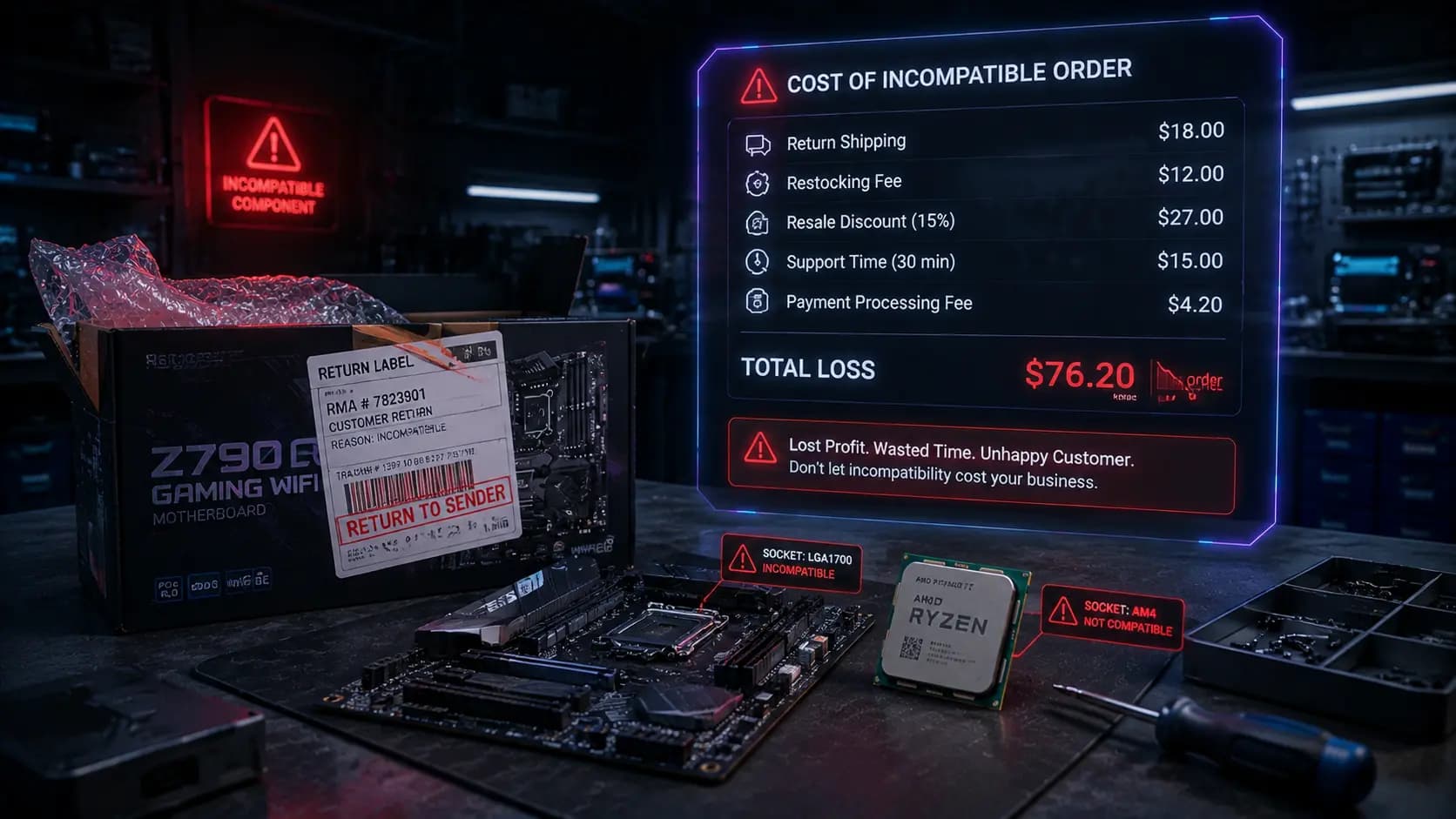
The Hidden Line Item on Every PC Parts Store's P&L
Quick Summary: An incompatible PC part order rarely ends at a refund. Between return shipping both ways, restocking labor, discounted resale of opened components, and the support time spent before and after the sale, a single incompatible order can commonly cost a store the equivalent of 15-30% of that order's value — before counting the customer who doesn't come back. Catching incompatibility at the point of selection, instead of after checkout, is what actually fixes this.
Most PC parts stores track returns as a percentage of revenue and call it a day. That number hides the real story. A returned t-shirt costs you shipping and a bit of restocking. A returned CPU that doesn't fit the customer's motherboard costs you shipping, restocking, a support ticket thread, a partial write-down on resale, and — quietly — a customer who now associates your store with a mistake they made because your product pages didn't stop them from making it.
If you sell CPUs, motherboards, RAM, GPUs, PSUs, and cases as independent products, compatibility mistakes are not an edge case. They're a predictable, recurring cost center. This article breaks down where that cost actually comes from and what changes when you check compatibility before the order is placed instead of after.
Why PC Parts Are Uniquely Exposed to This Problem
Most ecommerce categories don't have this issue. A customer buying a jacket in the wrong size gets a straightforward exchange. A customer buying an AM5 motherboard when their CPU is AM4 hasn't bought "the wrong size" — they've bought a product that will never work with the other product they already own or already ordered, and often won't realize it until they try to build the system.
The Combinations Are Invisible to the Customer
A CPU and a motherboard are compatible or not based on socket type and chipset — information that isn't obvious from a product photo or a price tag. A PSU is adequate or not based on the combined power draw of parts the customer may be buying in the same order or already owns. A case fits a motherboard or doesn't based on form factor. None of this is visible the way "size" or "color" is visible in other categories.
The Failure Shows Up Late
With clothing, the customer knows within seconds of trying it on. With PC parts, the failure often shows up during assembly — sometimes days after the order arrived, after packaging has been opened and components have been handled. That timing alone changes the return from a simple "doesn't fit, send it back" into a more expensive, more frustrating process for both sides.
What an Incompatible Order Actually Costs
Breaking the cost into its real components makes the size of the problem clear. These are illustrative ranges based on typical small-to-mid PC parts store operations — treat them as a framework for estimating your own numbers, not verified industry benchmarks.
Cost ComponentWhat It CoversTypical Illustrative RangeReturn Shipping (Inbound)Prepaid or reimbursed label for the customer to send the part back$8 – $25 depending on component size/weightRestocking LaborReceiving, inspecting, repackaging, re-shelving or re-listing$5 – $15 in staff timeResale DiscountSelling an opened-box CPU/GPU/motherboard below new price5% – 20% off original priceSupport Time (Pre-Sale)Answering "will this work with..." questions before purchase$3 – $10 in staff time per inquirySupport Time (Post-Sale)Diagnosing the incompatibility, arranging the return, replacement guidance$10 – $25 in staff timeLost Repeat PurchaseCustomer who doesn't return after a frustrating build experienceHard to quantify, often the largest cost
Add these up on a single $200 CPU return and you can land anywhere from $30 to $75 in direct handling cost alone, before the discounted resale value and before the support hours spent getting there. On higher-ticket items like GPUs or full component bundles, the absolute numbers scale up accordingly.
The Direct Costs: Shipping, Restocking, Resale
Return shipping for PC components is rarely cheap — GPUs and cases are bulky, PSUs are heavy, and anything with a CPU or motherboard needs careful packaging to avoid transit damage on the way back. Once it arrives, someone has to inspect it, confirm it wasn't damaged, decide whether it can be resold as new or has to go into an open-box or clearance channel, and physically restock it. Every one of those steps is real time from a real employee.
Components that have been opened, even briefly, often can't be resold at full price. A motherboard pulled out of its box to check a socket size, or a CPU that was seated and then removed, typically has to move through an open-box or discount channel — turning a full-margin sale into a reduced-margin one, sometimes at a loss once handling cost is included.
The Indirect Costs: Support Time, Before and After
The support cost of compatibility issues doesn't start after the order — it starts before it. Every store selling individual PC components fields a steady stream of pre-sale questions: "Will this PSU handle this GPU?", "Is this RAM compatible with this motherboard?", "What CPU cooler fits this case?" Answering these well takes real technical knowledge and real time, and answering them badly (or not at all) is what produces the incompatible order in the first place.
After the order, the cost shifts to diagnosing what went wrong, explaining it to a customer who is often mid-build and frustrated, and walking them through a return or exchange. This is typically the most time-intensive support interaction a PC parts store handles, because it usually requires someone with genuine product knowledge rather than a scripted response.
The Cost You Can't Put a Number On: Trust
A customer who receives an incompatible part rarely blames themselves first. They blame the store for not warning them. That reaction shows up in negative reviews, lower repeat-purchase rates, and word-of-mouth within PC-building communities that are unusually active online. Unlike shipping or restocking cost, this one compounds — a single bad compatibility experience shared in a forum or review can influence far more than one future sale.
Why This Keeps Happening on Standard Ecommerce Setups
A standard product catalog treats every product as independent. Nothing on a plain product page stops a customer from adding an AM5 motherboard and an AM4 CPU to the same cart — the store has no mechanism to know those two products relate to each other at all, let alone that they conflict.
Generic product-option apps don't solve this either, since they typically add variant-style choices (color, size, capacity) to a single product rather than validating relationships across separate products in a cart. The compatibility problem is fundamentally a cross-product problem, and most ecommerce tooling is built around single-product logic.
How Proactive Compatibility Checking Changes the Economics
The fix isn't better return policies or faster support responses — those only reduce the cost of a mistake that already happened. The fix is preventing the incompatible combination from being selectable in the first place.
Catch It at Selection, Not at Checkout
When compatibility rules — socket and chipset matching, memory type validation, power draw totals against PSU wattage, case and motherboard form factor checks — are applied while the customer is choosing components, an incompatible combination simply isn't offered. There's no order to return, no support ticket to answer, no opened-box component to discount, because the mismatch never became an order.
Reduce Pre-Sale Support Load
A guided configuration flow that only shows compatible options at each step answers the "will this work with..." question automatically, for every customer, without staff involvement. That's support capacity freed up for the questions that actually need a human — build advice, use-case recommendations, and post-sale service.
Improve the Post-Sale Experience for Everyone Else
Fewer incompatible orders means fewer stressful mid-build support conversations, which means more of your support bandwidth goes toward proactive, positive touchpoints — build tips, upgrade suggestions, and general product guidance that builds the kind of trust that drives repeat purchases.
What to Do If You're Already Seeing This Cost
If incompatible orders are already a recurring line item, the practical starting point is auditing where they cluster. Most stores find the majority of issues concentrate around a small number of relationships: CPU-to-motherboard socket mismatches, PSU wattage shortfalls against GPU power draw, and RAM speed or form factor mismatches with motherboards. Addressing compatibility validation for those categories first typically captures most of the available savings before expanding rules across the full catalog.
Frequently Asked Questions
How much does a single incompatible PC part return typically cost a store?
It varies by component and shipping distance, but combined return shipping, restocking labor, and resale discount commonly land in the range of 15-30% of the item's price once all handling steps are counted — before factoring in support time or the risk of losing the customer.
Which component mismatches cause the most returns?
CPU-to-motherboard socket and chipset mismatches, PSUs that are underpowered for the GPU and other components in the build, and RAM that doesn't match the motherboard's supported memory type or form factor are the most common sources of incompatible PC part orders.
Do generic ecommerce return policies solve this problem?
No. A flexible return policy reduces customer frustration after the fact, but it doesn't reduce the shipping, restocking, and resale-discount costs the store absorbs, and it doesn't prevent the support burden of diagnosing what went wrong.
Can compatibility checking eliminate returns entirely?
Not entirely — customers can still return parts for reasons unrelated to compatibility, such as changing their mind or finding a better price elsewhere. But validating compatibility at the point of selection removes the specific category of returns caused by a part simply not working with the rest of the build.
Is this worth solving for a small PC parts store, or only large catalogs?
Even a modest catalog of CPUs, motherboards, GPUs, and PSUs creates enough cross-product combinations for mismatches to happen regularly. Smaller stores often feel the support-time cost more acutely, since there are fewer staff members available to handle pre-sale and post-sale compatibility questions.