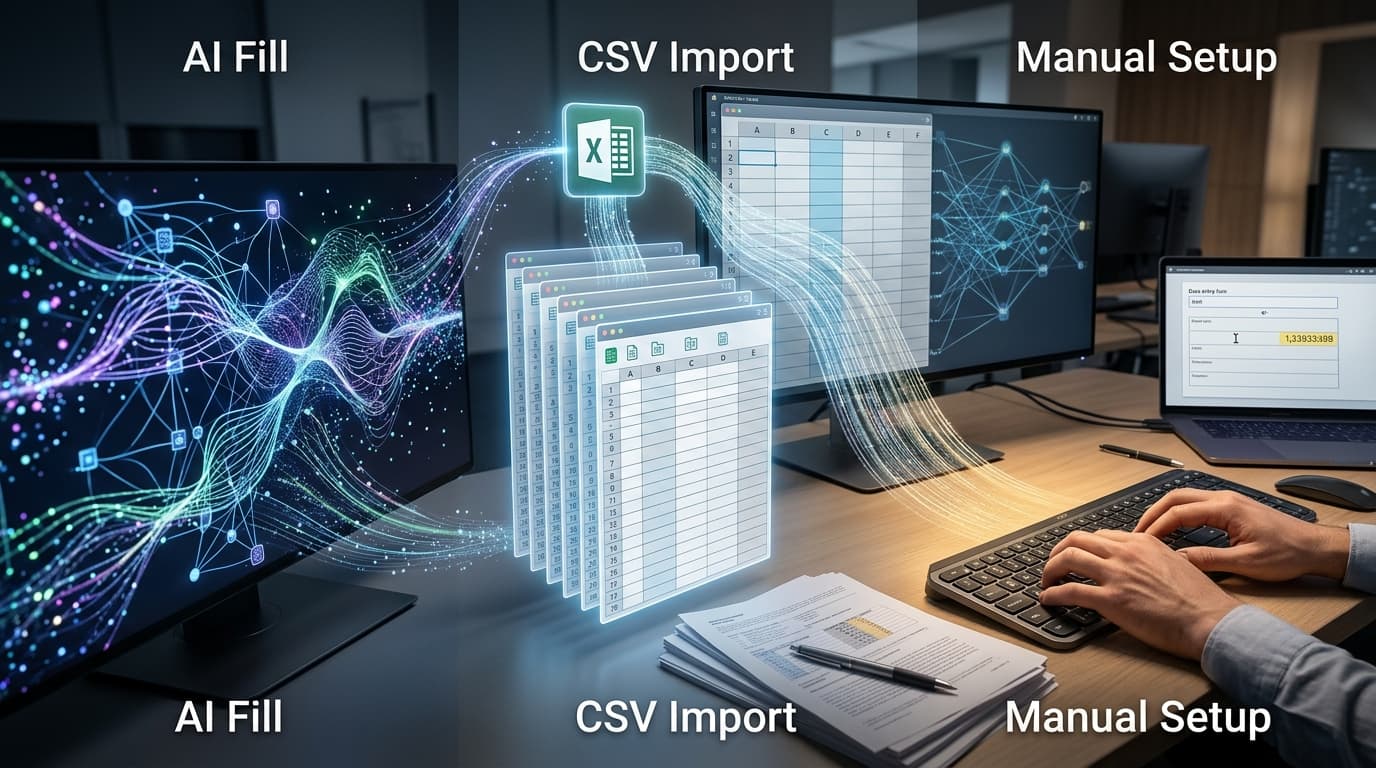
Navigating Data Entry: AI Fill, CSV Import, or Manual Setup?
Quick Summary: The best data entry method depends on data volume, complexity, and required accuracy. AI Fill excels with pattern recognition and large, semi-structured datasets; CSV Import is ideal for bulk, standardized data transfers; while Manual Setup offers precision for small, unique, or highly sensitive entries.
In the realm of data management, efficiency is paramount. Businesses constantly grapple with the challenge of inputting vast amounts of information accurately and quickly. The choice between AI Fill, CSV Import, and Manual Setup isn't just a technical decision; it's a strategic one that impacts productivity, data integrity, and operational costs.
Understanding the nuances of each method is crucial for optimizing your workflow and ensuring your data serves its intended purpose effectively. Let's dive into the specifics of these three common approaches.
What is AI Fill and How Does It Work?
AI Fill, often found in modern spreadsheet software like Google Sheets or Microsoft Excel, and increasingly in CRM or ERP systems, leverages artificial intelligence to recognize patterns and automatically complete data entries. This technology analyzes existing data to predict and suggest subsequent entries, significantly speeding up repetitive tasks.
For instance, if you're entering a list of names and the AI detects a pattern in email addresses or phone numbers based on previous entries, it can suggest or auto-fill the remaining fields. This capability extends beyond simple sequences, often handling complex data transformations and categorizations.
While incredibly fast for large, patterned datasets, AI Fill's accuracy can be compromised by inconsistent data or highly unique entries. It thrives on predictability but may introduce errors if the underlying patterns are flawed or ambiguous.
Understanding CSV Import: The Structured Approach
CSV (Comma Separated Values) import is a widely adopted method for transferring large volumes of structured data between different applications or databases. A CSV file is a plain text file where each line represents a data record, and fields within the record are separated by commas or other delimiters.
This method is particularly effective for bulk data migration, updating existing records, or populating new systems with standardized information. Its simplicity and universal compatibility make it a go-to for many businesses, from e-commerce platforms managing product inventories to financial institutions handling transaction logs.
However, successful CSV imports demand meticulous data preparation. Formatting inconsistencies, incorrect data types, or misaligned columns can lead to failed imports or, worse, corrupted data within your system. Data mapping—ensuring fields in your CSV match the target system's fields—is a critical step.
Manual Data Entry: Precision and Control
Manual data entry involves a human operator physically typing or inputting information into a system. Despite the advancements in automation, this method remains indispensable for certain scenarios, particularly when dealing with small batches of highly unique, sensitive, or unstructured data that defies automated processing.
The primary advantage of manual entry is the human element of judgment and oversight. An operator can interpret complex information, correct subtle errors on the fly, and handle exceptions that AI or structured imports might miss. This ensures a high degree of accuracy for critical, low-volume data.
Conversely, manual data entry is the most time-consuming and labor-intensive method. It is highly susceptible to human error when performed repetitively or at scale, leading to potential inconsistencies and increased operational costs. For large datasets, it quickly becomes impractical and inefficient.
AI Fill vs. CSV Import vs. Manual Setup: A Comparative Analysis
To help you decide, here's a direct comparison of the three data entry methods across key parameters:
ParameterAI FillCSV ImportManual SetupSpeedVery High (for patterned data)High (for bulk data)LowAccuracyHigh (if patterns are clear)High (if data is clean & mapped)Very High (for small, complex data)ScalabilityHighVery HighLowComplexityModerate (initial setup/training)Moderate (data preparation/mapping)Low (per entry)CostLow (software/subscription)Low (tools often built-in)High (labor)Ideal Use CaseRepetitive, semi-structured data with patternsBulk, standardized data transfers/migrationsUnique, sensitive, small-batch, or complex data
Which Method Is Best for Your Business?
The optimal data entry strategy is rarely a one-size-fits-all solution. It often involves a combination of these methods, strategically applied based on the specific data and business context.
When to Choose AI Fill
Opt for AI Fill when you have large datasets with discernible patterns, such as customer addresses, product descriptions following a template, or financial transaction categories. It's excellent for enhancing productivity in tasks that involve repetitive data entry where a degree of predictability exists.
When to Opt for CSV Import
CSV Import is your best bet for migrating entire databases, updating product catalogs, or integrating data from external sources. If you're dealing with vast quantities of structured data that needs to be moved or updated in batches, CSV provides a robust and efficient solution, provided your data is clean and well-prepared.
When Manual Setup is Unavoidable
Reserve manual data entry for critical, low-volume tasks where human judgment is indispensable. This includes entering highly sensitive client information, unique research data, or complex legal documents where every character must be precisely verified. It's also suitable for initial data setup before automation can be implemented.
"The future of data entry isn't about eliminating human involvement entirely, but about intelligently augmenting it with AI and automation to free up human potential for higher-value tasks." - Data Management Expert
Frequently Asked Questions
Is AI Fill always more accurate than manual entry?
No, AI Fill's accuracy depends on the clarity and consistency of patterns in the data. For highly unique or unstructured data, manual entry with human oversight can achieve higher accuracy.
What are common errors with CSV imports?
Common errors include incorrect delimiters, mismatched data types (e.g., text in a number field), missing required fields, and encoding issues, all of which can lead to failed imports or corrupted data.
Can I combine these data entry methods?
Absolutely. A hybrid approach is often the most effective, using CSV for bulk data, AI Fill for repetitive pattern-based entries, and manual setup for exceptions or highly critical, unique data points.
How does data volume impact method choice?
For small data volumes, manual entry is feasible. As data volume increases, AI Fill and especially CSV Import become significantly more efficient and cost-effective due to their scalability.
What tools support AI Fill capabilities?
Many modern spreadsheet applications like Microsoft Excel and Google Sheets offer AI Fill features. Advanced CRM, ERP, and data management platforms are also increasingly integrating AI-driven data completion functionalities.
The Future of Data Entry: Hybrid Approaches and Automation
As businesses continue to generate and consume more data, the lines between these methods will blur, leading to more sophisticated hybrid solutions. AI will increasingly assist in cleaning and preparing data for CSV imports, and even guide manual entry with intelligent suggestions. The goal remains consistent: to achieve maximum data accuracy and operational efficiency with minimal human effort, allowing teams to focus on analysis and strategic decision-making rather than tedious input tasks.